What Is a Tencel Fabric? A Quality Inspector on Why “Cheap” Textiles Cost the Most
The Question I Hear Every Week: “Which Towel Material Is Best?”
Last fall, a friend texted me two photos: a stack of four discount towels on sale, and one mid-priced towel next to them. “Which should I get?” she asked.
I typed back a question instead of an answer: “Which one do you want to replace in six months?”
She didn’t love that response.
But that’s the thing about fabric. When it’s your own money, the sticker price is the only thing you can see. Everything else — how long it actually lasts, whether it irritates your skin, whether it still looks decent after thirty washes — is invisible at the moment of purchase.
Four years of reviewing fabric batches as a quality inspector has taught me something that still surprises people: the price tag is a poor predictor of what a fabric will actually cost you.
I’ve seen $12 towels get replaced four times in three years while a $28 towel barely looked worn. I’ve seen skin irritation traced back to finishing chemicals that were never mentioned in the marketing copy. And I’ve seen “performance velvet” couches start looking tired after eighteen months because the fabric itself was, honestly, not much more than woven polyester with a stain spray.
This isn’t a “you get what you pay for” lecture. It’s simpler and more annoying: most of us don’t know how to read what a fabric actually is. I didn’t, either, until my job made me.
What Is a Tencel Fabric? (And Why Fiber Labels Are Almost Useless)
Let’s answer the literal question first, because it comes up constantly.
Tencel is a brand name. It refers to specific lyocell and modal fibers produced by Lenzing AG, an Austrian company. The fiber starts as wood pulp — mostly eucalyptus — and is manufactured in a closed-loop process where the solvent used to dissolve the pulp is captured, recycled, and reused. Lenzing puts the recovery rate at above 99%.
From my side of the table, the most interesting thing about Tencel is consistency. When I review a spec for a Tencel lyocell twill, I know what the fiber diameter should be. I know the shrinkage range. I know the dye uptake behaves predictably across batches. In my line of work, predictability is worth more than almost any single performance claim. (I wish “predictable” could be printed on a marketing tag — but apparently it doesn’t sell.)
Does that make Tencel “better” than cotton? Not abstractly. Cotton is superb for plenty of uses, and I’d never argue that any natural fiber category is inferior. But a well-made lyocell or modal brings something to the table that a lot of discount textiles don’t: you know what you’re actually getting.
And here’s the bad news: a fiber content label doesn’t tell you that. I can label something “rayon” and it might be beautifully manufactured — or it might be a lower-grade viscose with unknown pulp, cheaper processing chemicals, and finish residue stuck in the fiber. The label tells you the category. It says nothing about the quality within the category. That’s like saying “seafood” on a menu tells you how fresh the fish is. It doesn’t.
I once tested a “100% rayon” scarf that smelled faintly like solvent straight out of the package. I remember thinking that got finished by someone in a hurry. It wasn’t representative of the whole category, but it stuck with me. Those are the batches that cause problems downstream.
What Fabric Mistakes Actually Cost You
This is where total cost thinking comes in. And it’s the most important part, so bear with me.
In Q1 2024, our team rejected 11% of first-delivery fabric lots. Most weren’t dramatic failures. They were small spec deviations: fabric weight off by 5%, shrinkage outside the agreed range, dye lots that didn’t match the approved sample. A normal shopper wouldn’t catch any of those in a store. But each one shortens the life of the finished product, or raises the odds of a reaction later. That is the hidden cost nobody prices into the “bargain.”
Textile Contact Dermatitis: When Your Clothes Fight Back
Textile contact dermatitis is not a “sensitive people” myth. It’s a recognized condition, and common triggers include disperse dyes and formaldehyde-based finishing resins (Source: DermNet, 2024). Formaldehyde resins show up often in easy-care or wrinkle-resistant finishes. Which garments carry those finishes most? In my experience, the low-end ones that have to look smooth on the rack without real fiber quality behind them.
I have a very personal data point here. In early 2023, I bought a scarf — a “rayon blend” from a fast-fashion chain — for $14. (Yes, I know. A fabric QC person buying an unknown-fiber scarf. I still cringe.) Within 24 hours, I had an angry red patch around my neck. My dermatologist took one look at the rash pattern and asked, “New scarf?”
I threw it out. So let’s total that bargain: $14 for the scarf, a $120 co-pay, three weeks of itching, and a new permanent rule about never buying a scarf without knowing the fiber content and finish. Meanwhile, the Tencel scarf I own — from a brand that actually puts specs on their label — has survived two winters with zero skin issues. That extra $10 upfront turned out to be the cheapest part of the whole equation.
Am I saying cheap rayon is automatically dangerous? No. That would be sloppy and unfair. I’ve seen excellent viscose, and I’ve seen cotton garments cause the same issues. The difference is that with a reputable, spec-transparent product, you’re not rolling dice on chemical residues. That certainty has value, even if you can’t touch it in the store.
The “Best Towel Material” Question, Solved With Math
The “best towel material” is one of those questions people genuinely Google (the search volume spikes, I checked). The honest answer: it depends less on the fiber than on the quality of that specific textile.
Here’s the pattern I see in testing.
A discount cotton towel — often 300 to 400 GSM, low-twist yarn — feels fine off the shelf. But the yarn pills fast, absorbency drops noticeably within six months, and the color goes dull. Retail price: $8 to $12.
A well-constructed modal or cotton-modal towel — usually 500 to 600 GSM, denser weave — costs $25 to $35. It holds its structure for two to three years of regular machine washing, and absorbency actually improves after the first few washes (weirdly, that’s a known thing with good modal).
Now do the three-year math. Four $10 towels: $40 to $48, and you’re still buying replacements. One $30 towel: $30, and it’s still going. The “premium” option is objectively cheaper before you even count the time spent shopping for towels again.
We actually ran a small blind test at work last year: same towel design, same mill, one made with generic rayon and one with Tencel modal. Nine out of twelve people who touched both called the modal one softer. It wasn’t a rigorous study, but it changed how our procurement team writes specs.
And this isn’t a cotton-versus-modal argument. A great 600 GSM Turkish cotton towel will outlast a mediocre modal one any day. The point is that construction quality matters more than the fiber on the tag, and cost per useful year beats sticker price every time.
The “Performance Velvet Couch” That Quietly Costs $2,300
“Performance velvet” is a marketing term, not a specification. It usually means a stain-resistant treatment on top of a synthetic face — often polyester or nylon. And to be fair, it does repel spills. Initially.
The tradeoffs show up later. Synthetics trap heat, some generate static, and lower-quality versions crush and mat within a year of real living-room use. I’ve sat on a “performance velvet” sofa that felt like a pillow had been used as a road for six months. There was a permanent sheen wherever people actually sat.
Let’s run the TCO on that. An $800 “performance velvet” sofa goes home. Eighteen months in, the cushions look tired, and you start researching reupholstery. In my area, reupholstering a standard three-seater runs roughly $1,000 to $1,500 (based on quotes I’ve seen, early 2025 — verify locally). Congratulations: your $800 bargain now costs $1,800 to $2,300, and you still don’t have the ten-year couch you wanted.
I’m not saying you need a $4,000 designer sofa. I’m saying check what’s underneath that “performance” label. Tencel lyocell shows up in upholstery velvets more and more, often blended with polyester or nylon for durability. Done right, that’s a breathable, reasonably durable fabric. But you only know that if the brand specifies the fiber breakdown. If a product page just says “performance velvet” with no fiber content listed, that’s a red flag. Manufacturers who use good fibers will tell you.
Three Rules I Actually Use Before Buying Any Fabric
Quick caveat: I can only speak to apparel and home textiles from personal experience. If you’re buying contract upholstery for hotels or healthcare, the math changes — different durability standards, laundering requirements, flammability regulations. This is not that.
But for your own towels, scarves, and couches, three rules cover most of it:
- Demand the fiber breakdown. If a product won’t tell you exactly what it’s made of, the manufacturer either didn’t know or didn’t want you to know. Both are bad answers when it’s your skin and your money.
- Trust certifications over adjectives. OEKO-TEX Standard 100 means a textile has been tested against a specific list of harmful substances (Source: oeko-tex.com). FSC certification on Tencel’s wood sourcing is verifiable. “Buttery soft” is just marketing.
- Calculate cost per useful year, not cost per item. A $28 towel over three years is about $9 per year. A $10 towel over one year is $10 per year. The numbers are close on paper, but the experience isn’t. On sofas, the difference gets embarrassing fast.
The most expensive fabric is rarely the one with the higher price tag. It’s the one you have to buy twice, live with, or put on your skin before you find out what was hidden in it. That’s the real total cost. And it’s a lesson I wish more people could learn without the itchy rash.
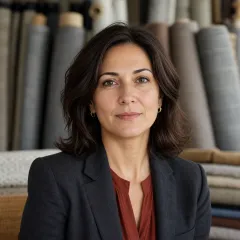
Lucia Bianchi
Lucia Bianchi is a woven apparel-fabric analyst covering cotton, linen, wool, rayon, denim, shirting, twill, satin, poplin, and blended garment fabrics. She applies the ISO 1833 series for fibre composition and ISO 105-C06 for laundering colourfastness while checking GSM, yarn count, usable width, shrinkage, skew, shade grade, drape, and surface defects. Her specification guides help designers, sourcing teams, and mills align fibre claims, lab dips, bulk tolerances, care conditions, and garment performance before production approval.